
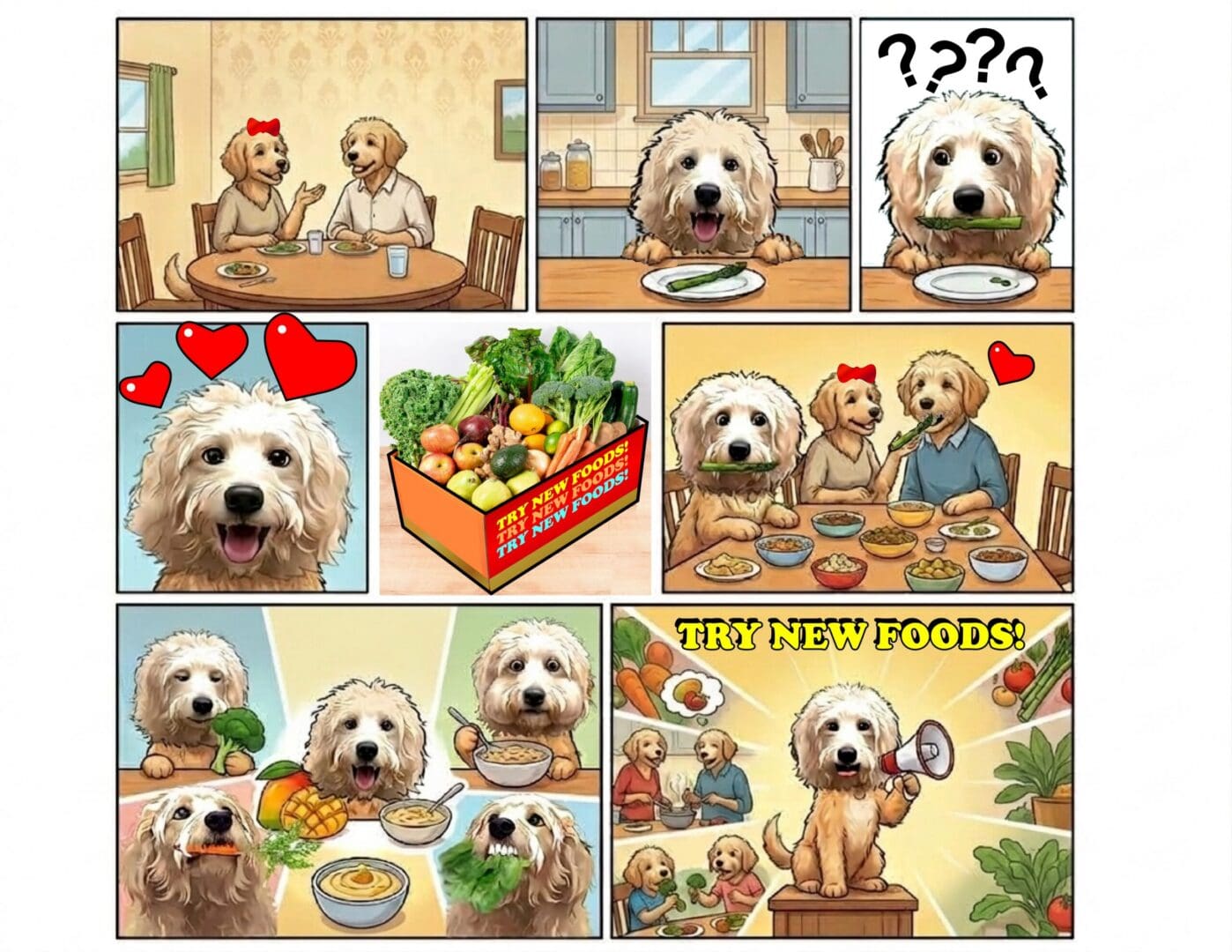
Harvey Tries Something New
Nutrition Story & Activity Package
Harvey loves breakfast, lunch, dinner—and especially snacks! But when something unfamiliar appears at mealtime, he’s not so sure.
Join Harvey as he learns how breakfast can help give us energy to start the day, how different foods help fuel growing bodies, and why something we didn’t like before might deserve another taste. Then take Harvey’s One-New-Thing Challenge and see what you discover!
Get Harvey's One-New-Thing Challenge Activity Here!
Health & Wellness | Nutrition • Healthy Eating • Trying New Foods • Family Mealtimes
Harvey Tries Something New
Hi, friends! Harvey here.
I have something important to tell you about me.
I like food. A lot.
I like breakfast. I like lunch. I like dinner. I especially like snacks.
“Harvey!” Mom says. “Remember that not everything people eat is safe for dogs.”
Oh, right. That.
So I have learned an important rule: I only eat foods my grown-ups say are safe for me.
Breakfast First
One morning, I woke up very hungry.
My tummy was definitely ready for breakfast.
“Breakfast helps give us energy to start the day,” Mom said. “Your body has gone all night without food, and now it needs fuel for everything you want to do.”
That made sense to me. I had a busy morning planned. There were squirrels to watch, toys to find, and probably a walk to take.
Kids have busy mornings, too. They need energy to learn, think, play, and grow.
Breakfast doesn’t have to be fancy. Kids might have oatmeal with fruit, eggs and whole-grain toast, yogurt with berries, or toast with banana and peanut or seed butter.
I have my own breakfast because dogs need foods that are right for dogs.
But everybody needs fuel to get the day started.
Little Fuel Stops
Later, I heard someone open the refrigerator.
I know that sound.
Snack time!
I used to think snacks were just treats. But snacks can also be little fuel stops between meals.
Kids might choose apple slices, berries, carrots, cucumber, yogurt, cheese, bananas, or whole-grain crackers.
Some fruits and vegetables can be snacks for dogs, too—but only if a grown-up says they’re safe.
I happen to enjoy carrots.
They’re crunchy.
Crunching is one of my talents.
And don’t forget water! Whether you’re running on two legs or four, your body needs water throughout the day.
What’s for Lunch?
At lunchtime, I started thinking about all the different things kids might eat.
Some like sandwiches or wraps. Some like soup. Some bring leftovers from dinner. Some kids eat lunch at school. Lunch might include fruit, vegetables, yogurt, cheese, beans, rice, chicken, or foods that are special in a family’s culture.
There isn’t just one lunch that works for everybody.
Eating different kinds of foods helps our bodies get the different things they need.
Then I noticed something unfamiliar on the table.
I sniffed it.
I looked at Mom.
“No, thank you,” I said.
“You haven’t even tried it,” she said.
“I don’t like it.”
“When did you last try it?”
I thought about that.
A long time ago.
Maybe a VERY long time ago.
Dad smiled.
“You know, Harvey, sometimes we don’t like something the first time we taste it. And sometimes our tastes change as we grow.”
Wait.
My taste buds can change?
Interesting.
The One-New-Thing Challenge
That’s when my family came up with an idea.
Once every week, we would try one new thing.
It could be a food we’d never tasted before.
Or it could be something we’d tried a long time ago and thought we didn’t like.
Nobody had to love it.
Nobody had to clean a plate full of it.
We would just give it a try.
I liked those rules.
So I tried my food.
One bite.
I chewed.
I thought.
I chewed some more.
Hmm.
I didn’t love it.
But…
I didn’t hate it either.
So I tried another bite.
“Not bad!” I decided.
Everyone laughed.
The next week, we tried something else.
Some new foods were crunchy. Some were soft. Some were sweet. Some were tart.
There were things I liked.
There were things I didn’t like.
And there were things I wasn’t sure about yet.
That’s okay!
Trying something doesn’t mean you have to like it.
It means you’re curious enough to find out.
Food Helps Us Do Amazing Things
I’m learning that food isn’t just about filling up my tummy.
Food gives our bodies energy.
It helps kids grow, learn, play, think, and explore.
Different foods give our bodies different things they need.
And eating can be fun, too. We can cook together, eat together, talk together, and learn about foods that other families enjoy.
Sometimes we can even discover a new favorite.
So here’s my challenge for you:
Try one new thing this week.
Maybe it’s a fruit you’ve never tasted.
Maybe it’s a vegetable cooked a different way.
Maybe it’s a food your friend or family loves.
Or maybe it’s something you tried when you were little and decided you didn’t like.
You are bigger now.
Maybe your taste buds have grown up a little, too!
And if you still don’t like it?
That’s okay.
You tried.
Maybe you’ll try it again someday.
That’s what learning is all about.
And now, if you’ll excuse me, I think I heard the refrigerator door.
Love,
Harvey
Talk About It
- What is your favorite breakfast? How does it help you get ready for your day?
- What are some snacks that give your body energy?
- What would you put in your favorite lunch?
- Have you ever tasted something you thought you wouldn’t like—and discovered that you did?
- Is there a food you didn’t like when you were younger that you might be willing to try again?
- What will you choose for your One-New-Thing Challenge this week?
- Why does Harvey need to ask his grown-ups before eating people food?
A Note for Parents and Caregivers
Learning to eat a varied diet is a process, not a single lesson. Children may need many low-pressure opportunities to see, smell, touch, or taste an unfamiliar food before becoming comfortable with it. Rather than pressuring children to eat or requiring them to “clean their plates,” make new foods an opportunity for exploration. You might consider having small portion sizes for children, making it easier to introduce new food.
Adults can model curiosity: “I wonder what this tastes like,” or “I didn’t like this when I was younger. I’m going to try it again.”
Offer a variety of foods over time, including fruits and vegetables, whole grains, protein foods, and other foods your family enjoys. Regular meals and snacks can help provide children with energy for growth, learning, and play. Water is an important everyday beverage, too.
Avoid labeling foods simply as “good” or “bad.” Food provides nourishment, but it is also part of family traditions, celebrations, cultures, and the pleasure of eating together. Avoid using food as a reward or punishment, and help children learn to notice when they are hungry and when they feel comfortably full.
It’s important to note that not everyone can eat every type of food safely. Be sure to ask a trusted adult.
Foods that are safe for children are not always safe for pets. Chocolate, grapes and raisins, onions, garlic, and products containing xylitol can be dangerous for dogs. Check with your veterinarian before offering a dog unfamiliar people foods.