
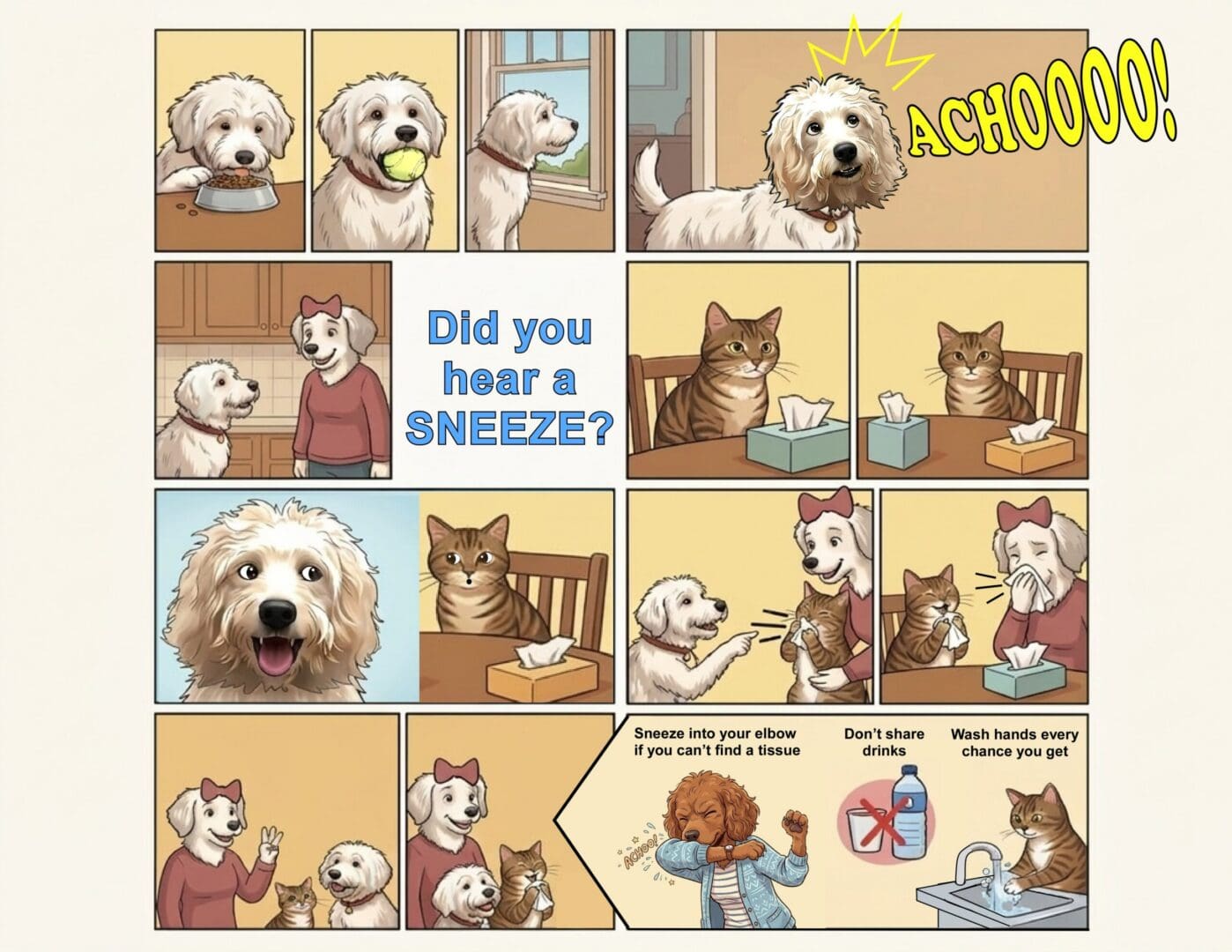
Harvey Hears “ACHOO!”
Harvey Hears “ACHOO!”
Hi, Friends! Harvey here.
I was having a very important morning.
I had already eaten breakfast, found my favorite ball, and checked the backyard for squirrels.
Twice.
Then I heard it.
“ACHOO!”
My ears popped up.
What was THAT?
I hurried into the next room.
“Did somebody sneeze?”
“Not me,” said Mom.
Then—
“ACHOO!”
There it was again!
I followed the sound.
The Mystery Sneezer
I found my friend Sally sitting at the table.
“Was that you?” I asked.
Sally nodded.
“Sorry,” she said.
“Why are you sorry?”
“I sneezed.”
I thought about that.
People sneeze. Cats sneeze. Dogs sneeze.
I have sneezed.
Once I sneezed three times in a row and scared myself.
“You don’t have to be sorry for sneezing,” I told her.
Just then—
“ACHOO!”
This time Sally grabbed a tissue, covered her nose and mouth, and sneezed into it.
“Good catch!” I said.
She threw the tissue away and washed her hands.
“You’re really good at this sneezing business.”
Sally laughed.
“I’ve had practice.”
Does a Sneeze Mean You’re Sick?
“Are you sick?” I asked.
“I don’t think so,” Sally said. “Sometimes I sneeze when there’s pollen in the air.”
That made sense.
I know about pollen. It makes some people—and some animals—itchy and sneezy.
Mom came into the room.
“People can cough or sneeze for lots of reasons,” she said. “Sometimes they’re sick. Sometimes they have allergies. Sometimes something just tickles their nose.”
“So we can’t tell why someone sneezed just by looking at them?” I asked.
“Exactly.”
That seemed important.
Because sometimes when we think someone might be sick, we can get worried.
And when people are worried, they don’t always say kind things.
Nobody Is “Germy”
“What if somebody at school sneezes?” I asked.
“You do the same things you always do,” Mom said. “Use healthy habits and be kind.”
That sounded easy enough.
Then she added something else.
“And we never call another person ‘germy’ or make fun of someone because they coughed or sneezed.”
That made sense to me.
Being sick isn’t something anyone chooses.
And sneezing doesn’t mean somebody did something wrong.
“So if Sally sneezes, she’s still Sally,” I said.
Sally looked at me.
“Of course I’m still Sally!”
“Just checking.”
Cover It. Wash It. Don’t Share It.
Mom helped us remember a few simple things we can all do.
Cover it.
If you cough or sneeze, use a tissue. If you don’t have one, cough or sneeze into your elbow instead of your hands.
Wash it.
Wash your hands with soap and water—especially before eating, after using the bathroom, and after blowing your nose, coughing, or sneezing into your hands.
Don’t share it.
Don’t share drinking cups, water bottles, forks, spoons, or other things that have been in someone’s mouth.
“And there’s one more,” Mom said.
Tell it.
“Tell it?” I asked.
“If you don’t feel well, tell a grown-up.”
That was a good one.
Grown-ups can help decide what you need.
Maybe you need a tissue.
Maybe you need water.
Maybe you need to rest.
And if you’re sick, maybe you need to stay home for a while.
One More ACHOO!
We went back to playing.
For a while, everything was quiet.
Then—
“ACHOO!”
Sally and Mom both looked at me.
“What?” I asked.
“You sneezed!” Sally said.
“I did?”
She laughed.
“Are you sick?”
“Nope. My nose tickled.”
Sally handed me a tissue.
“Good thing I don’t think you’re germy.”
I smiled.
“Good thing I’m still Harvey.”
And I was.
Because everybody coughs or sneezes sometimes.
We can take care of ourselves.
We can help take care of each other.
And we can always remember to be kind.
Love,
Harvey 🐾
Talk About It
- Why was Sally sneezing?
- Does every sneeze mean someone is sick?
- What can you use to cover a cough or sneeze?
- Why is it important to wash your hands?
- What things shouldn’t we share with other people?
- What should you do if you don’t feel well?
- Why shouldn’t we call another person “germy”?
- What did Harvey learn about being kind when someone coughs or sneezes?
A Note for Parents and Caregivers
Coughing and sneezing are normal body responses and can happen for many reasons, including coughs and colds, allergies, environmental irritants, or simply a temporary tickle in the nose or throat. Young children may assume that anyone who coughs or sneezes is “sick,” which can lead to fear, teasing, or exclusion.
Use everyday moments to teach both healthy habits and kindness.
Encourage children to cover coughs and sneezes with a tissue and dispose of the tissue promptly. When a tissue isn’t available, coughing or sneezing into the elbow or upper sleeve rather than the hands can help reduce the spread of respiratory germs.
Regular handwashing with soap and water is another important habit. Help young children learn when to wash and give them enough time to wash thoroughly.
Teach children not to share cups, water bottles, eating utensils, or other objects that have been in another person’s mouth.
Most importantly, remind children that becoming ill is not something to be ashamed of. A child who coughs, sneezes, or becomes sick deserves the same friendship, inclusion, and kindness as anyone else.
If your child develops symptoms of illness or you have questions about when your child should stay home from school or childcare, contact your child’s healthcare professional and follow your school or child-care program’s illness policies.
For current child-health information, families can consult the American Academy of Pediatrics through HealthyChildren.org.