
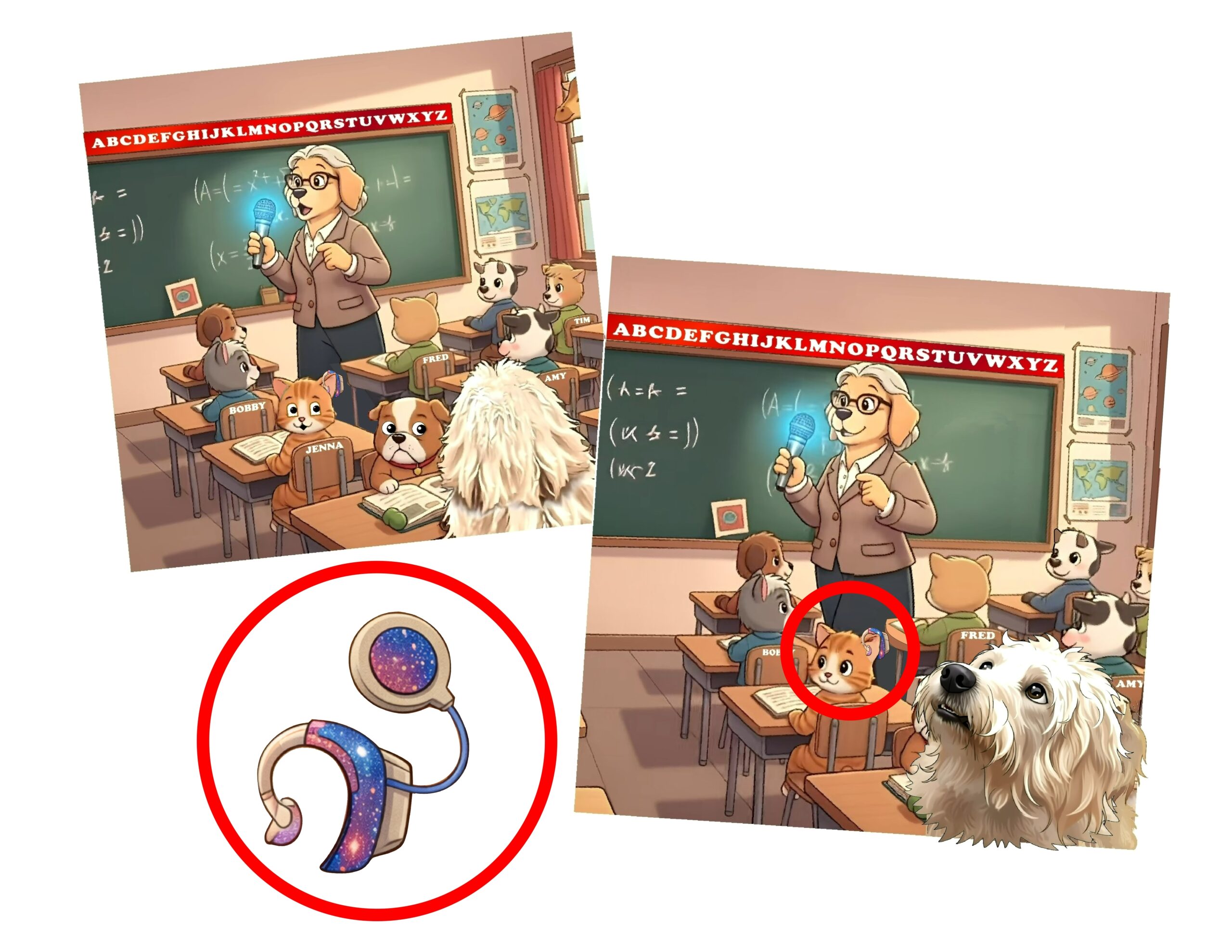
Harvey and the Listening Lights
A Bedtime Story about Hearing Differences and Communication
Harvey trotted into class, humming. Today the students were learning a new song.
He noticed Jenna, a girl with freckles and glittery hearing aids. She smiled as she watched the class get ready.
Ms. Porter played her guitar. The class began singing, and Jenna watched her teacher’s face carefully.
After the first verse, she joined in right on time.
At recess, Harvey asked, “Do your hearing aids play music?”
Jenna giggled.
“No! They help me hear better. I’m hard of hearing, so I use my ears and my eyes to understand people.”
“How do you do that?” Harvey asked.
“I watch people’s faces and lips,” Jenna said. “It helps me understand better when I can see them.”
Back in class, Ms. Porter showed a small light that blinked softly when she spoke into a microphone.
“This is one way we can make sure everyone knows when someone is talking,” she explained. “It helps all of us pay attention in different ways.”
During group work, Harvey turned toward Jenna.
“Want to build a tower with me?” he asked clearly.
Jenna smiled. “Thanks—it helps when I can see you.”
They worked together, stacking blocks higher and higher.
At the end of the day, Jenna showed Harvey something new.
“Some people use signs to talk, too,” she said, tapping her pointer fingers together. “This means ‘friend.’”
“You’re my friend,” Harvey signed back.
That night, Harvey said, “Jenna and I understand each other in different ways. When I face her, it helps us both communicate.”
His dad smiled.
“That’s called working together, Harvey.”
Talk About It
Use these questions to start a conversation:
- How did Jenna understand what people were saying?
- What did Harvey do to help them communicate better?
- Have you ever noticed someone communicating in a different way?
- What are some ways we can help each other understand better?
- Can you try making the sign for “friend”? Who would you share it with?
A Note for Parents and Caregivers
This story introduces children to hearing differences and inclusive communication in a simple, respectful way.
Some children are Deaf or hard of hearing. They may use hearing aids, visual cues, lip reading, or sign language to understand and communicate. These are not “fixes”—they are different and valid ways of connecting with others.
A key concept in this story is shared responsibility. Communication works best when everyone participates:
- Facing the person you are speaking to
- Speaking clearly and naturally
- Paying attention to visual cues
- Being patient and respectful
You may also notice the classroom uses tools (like a microphone and visual light) that support everyone. This reflects an important idea in education and public health: when we design environments to include everyone, everyone benefits.
Encourage your child to:
- Be curious and ask respectful questions
- Notice how others communicate
- Practice small actions that make communication easier for others
These early lessons help children build empathy, inclusion, and confidence in connecting with others—skills that last a lifetime.